Blog Details
03Sep
The 20-Day Horseback Journey to Lo Manthang: Following Mustang's Ancient Trails
Beyond the towering peaks of Annapurna and Dhaulagiri lies Upper Mustang, the historic heartland of the former Kingdom of Lo and one of Nepal’s most culturally distinctive regions. Often described as Nepal’s Last Forbidden Kingdom, Upper Mustang remained closed to foreign travellers until 1992 and continues to be a restricted area today.
Separated from Nepal’s greener middle hills by the dramatic Kali Gandaki Gorge, Upper Mustang feels like another world. Barren valleys stretch beneath towering cliffs, windswept plateaus open into wide horizons, and ancient caves appear in the rock faces above traditional settlements. Fortified villages, Tibetan Buddhist monasteries, prayer wheels, chortens, mani walls, and stone and mud-brick homes reveal a culture that has developed in close relationship with this demanding Trans-Himalayan environment.
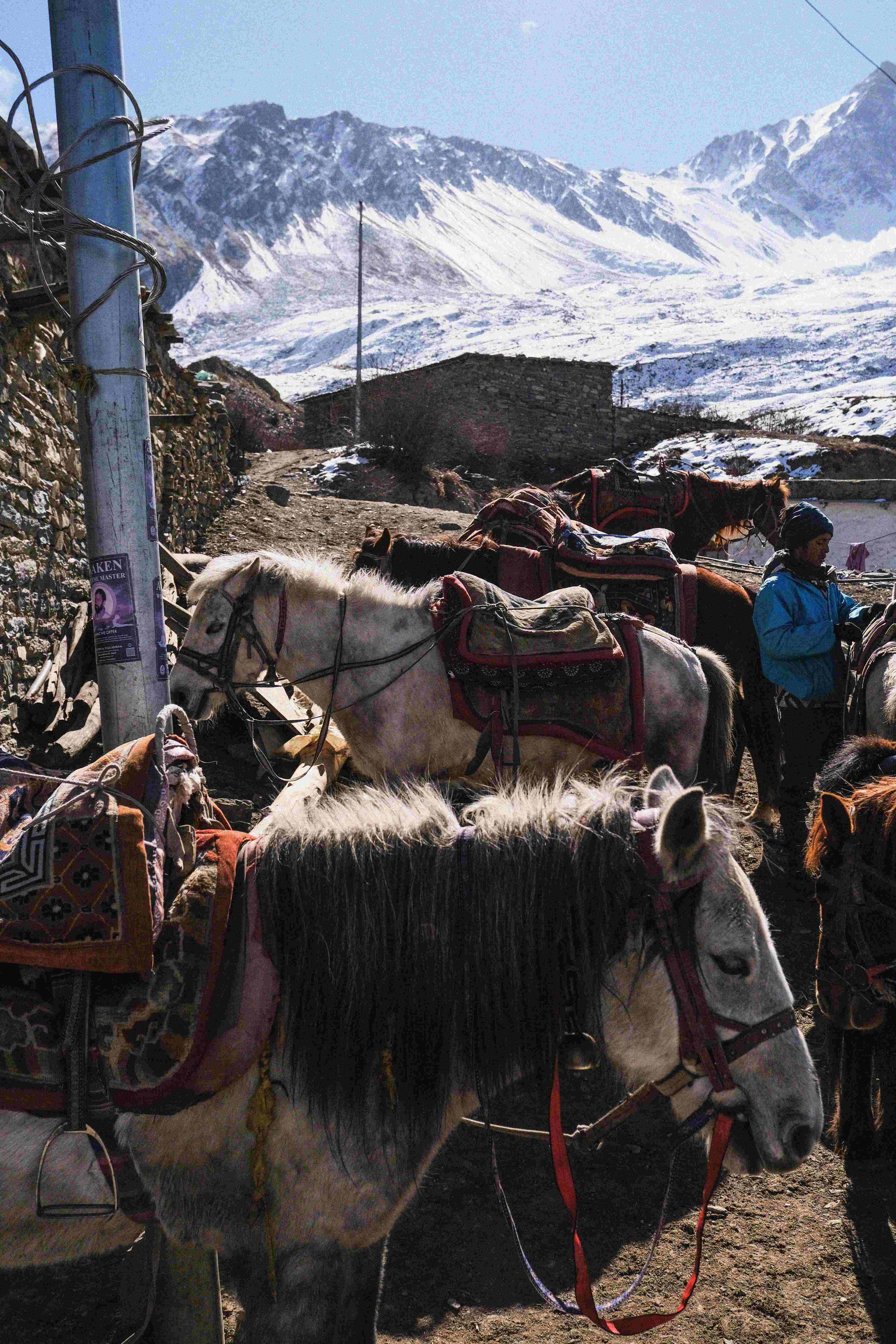
For centuries, this was a landscape of movement and exchange. Upper Mustang stood along important Himalayan trade routes connecting Nepal and Tibet, with salt, grain, wool, livestock, textiles, and everyday goods moving between remote settlements. Horses played an important role in this economy, carrying people and goods through terrain where roads did not exist.
Today, roads and modern vehicles have transformed transportation, but horses remain part of Mustang’s rural economy and cultural heritage. A horseback expedition therefore offers more than an alternative way of sightseeing. It provides a way to experience the landscape at a pace connected to the region’s own history.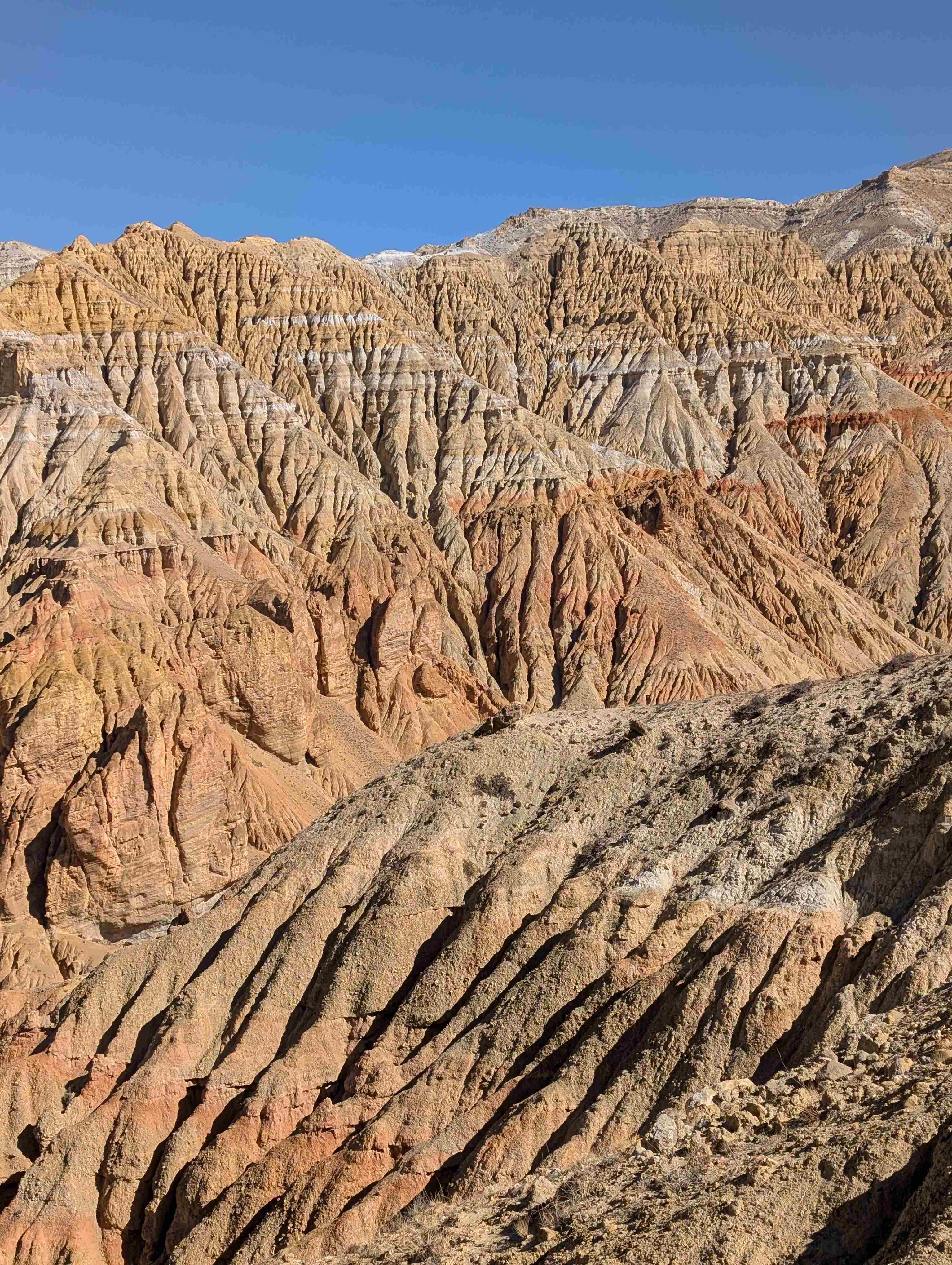
Why Take 20 Days to Reach Lo Manthang?
Lo Manthang can be approached in considerably less time, but a 20-day expedition offers something different. It gives the journey room to unfold.
Instead of treating Lo Manthang simply as a destination, the expedition follows the landscapes and settlements that lead towards it. The journey begins in Kathmandu, continues overland to Pokhara, crosses the Kali Gandaki Valley by jeep to Jomsom, and only then changes pace as you begin travelling on horseback towards Kagbeni and into restricted Upper Mustang.
From Kagbeni, the route continues through Chuksang, Samar, Giling, Ghami and Tsarang before reaching Lo Manthang. After spending a full day exploring the historic walled city, the journey continues through Dhakmar and Sangboche before returning through Samar, Kagbeni and Jomsom. From Jomsom, the expedition concludes with flights back to Pokhara and Kathmandu.
Twenty days allow you to experience not only where you are going, but everything that lies between Kathmandu and Lo Manthang.
The Journey Begins Before Upper Mustang
The expedition starts in Kathmandu, where the journey gradually moves away from the capital and towards the high Himalayas. From Kathmandu, you travel overland to Pokhara, following one of Nepal’s most familiar travel corridors before the landscape begins to change.
From Pokhara, a private 4WD Jeep takes you towards Jomsom through the Kali Gandaki Valley. The journey introduces the dramatic geography that defines Mustang, as the greener landscapes of central Nepal gradually give way to the drier environment of the Trans-Himalaya.
Jomsom marks an important transition.
Here, the road journey gives way to horseback travel. From Jomsom, you ride towards Kagbeni, the historic gateway to Upper Mustang, beginning the part of the expedition that follows mountain trails rather than travelling primarily by road.
Kagbeni: The Gateway to the Former Kingdom of Lo
Kagbeni is where the character of the journey begins to change. Situated at the entrance to Upper Mustang, it connects the landscapes around Jomsom with the restricted region beyond.
From here, the horse becomes your primary means of travel.
The journey moves through valleys and mountain trails rather than simply passing from one road-accessible destination to another. This slower pace creates opportunities to notice details that are easy to miss from a vehicle: prayer flags moving in the wind, mani walls beside the trail, cultivated fields around settlements, traditional homes, and the changing colours of the surrounding cliffs.
Riding Into the High Desert
As the trail moves deeper into Upper Mustang, the landscape becomes increasingly stark.
Deep river gorges open into barren plateaus, while enormous cliffs rise above the trail in layers of red, ochre, grey, and brown rock. The apparent dryness of the landscape can be deceptive. Around the villages, small areas of cultivated farmland bring patches of green to the otherwise arid surroundings.
Ancient caves can be seen in seemingly inaccessible cliffs, reminders of earlier settlements and generations that lived in close relationship with the mountains.
The landscape is not empty.
Monasteries, chortens, prayer wheels, mani walls, cultivated fields and traditional homes appear along the route, connecting the dramatic physical environment with the cultural traditions of the people who live here.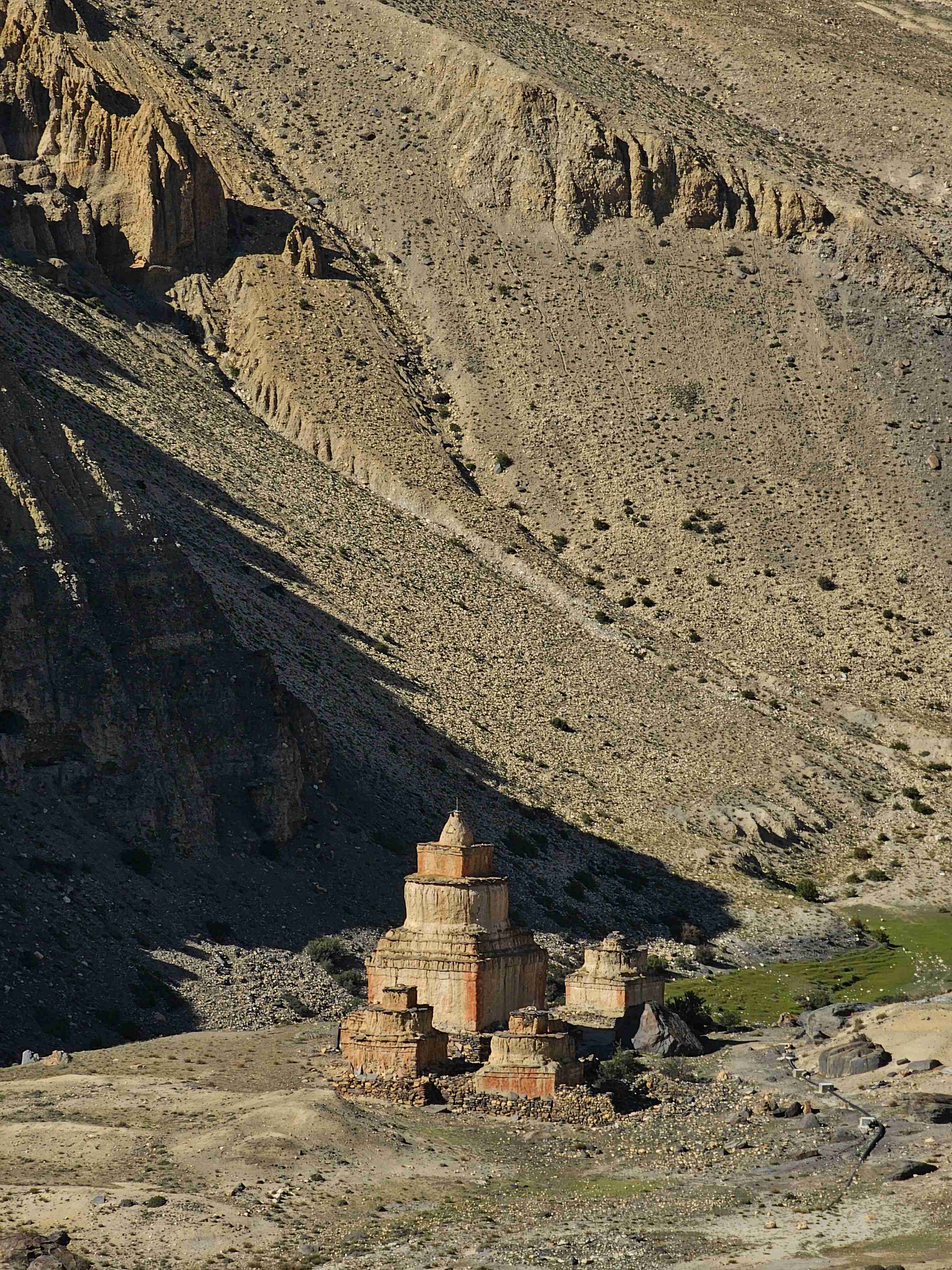
The Trail Is the Experience
One of the defining characteristics of this expedition is that the trail itself becomes part of the experience.
Travelling on horseback allows you to move between villages through a landscape that was historically travelled by people, animals and traders. Rather than watching Mustang pass quickly outside a vehicle window, you experience its changes gradually.
The pace of a horse is naturally different from that of a road journey.
There is time to observe the terrain, watch the colours of the cliffs change with the light, pass through small settlements and encounter the agricultural areas that make life possible in an otherwise harsh environment.
You also travel with local horsemen who understand the animals and the terrain. Their familiarity with trails, weather, altitude and local conditions is particularly valuable when the route passes through narrow gorges, exposed ridges, rocky riverbeds and high-altitude terrain.
Chuksang, Samar and the Changing Landscape
From Kagbeni, the route continues towards Chuksang and then Samar. With each stage, the character of the landscape changes.
The valleys become increasingly dry and open, while the surrounding cliffs create a sense of scale that is difficult to appreciate from lower regions of Nepal. Yet villages remain places of life and activity, with cultivated fields, livestock, traditional houses and religious structures providing a striking contrast to the surrounding desert-like terrain.
Samar is also an important point in the journey because the expedition includes an acclimatization day here.
At these elevations, allowing the body time to adjust is an essential part of a longer Himalayan expedition. The extra day also provides a natural pause before continuing deeper into Upper Mustang.
The journey is not designed simply to cover distance.
It is designed to give the landscape time.
Giling and the High Himalayan Trails
From Samar, the trail continues towards Giling, reaching approximately 3,806 metres.
At this altitude, the environment becomes increasingly characteristic of the high Trans-Himalayan landscape. The air is thinner, the vegetation more limited, and the surrounding mountains appear increasingly exposed and sculpted by wind and erosion.
The villages along the route remain essential points of connection in this remote landscape.
Agriculture, livestock and tourism continue to support local households, even as traditional livelihoods are changing. Roads have reached many parts of Upper Mustang, modern construction is increasingly visible, and younger generations increasingly leave remote settlements for education and employment elsewhere.
Yet the older cultural landscape has not disappeared.
Monasteries continue to function, festivals continue to be celebrated, and traditional practices remain part of everyday life.
Ghami: Where Landscape and Culture Meet
From Giling, the expedition continues to Ghami and then towards Tsarang.
Ghami sits within a landscape where the relationship between geology and settlement becomes especially striking. The surrounding cliffs display Mustang’s characteristic layers of colour, while the village itself reflects the architectural and cultural traditions that have developed in this high-altitude environment.
Across Upper Mustang, Buddhist structures and symbols form an integral part of the landscape. Chortens, mani walls, prayer wheels and monasteries are not isolated attractions placed along a tourist route. They are part of communities where Tibetan Buddhist traditions remain deeply embedded in everyday life.
This is one of the differences between travelling through Mustang and simply photographing it.
The landscape has meaning because people continue to live within it.
Tsarang: The Final Approach to Lo Manthang
From Ghami, the horseback journey continues to Tsarang before reaching Lo Manthang.
By this point, the journey has already passed through a succession of landscapes and settlements, each revealing another part of Upper Mustang. The destination is getting closer, but the expedition remains focused on the route itself.
The barren mountains, cultivated fields, traditional settlements and Buddhist heritage continue to appear together, creating a landscape where the natural and cultural environments are inseparable.
Then the direction of the journey changes from simply travelling through Mustang to approaching its historic centre.
Lo Manthang is ahead.
The Approach to Lo Manthang
The ride from Tsarang to Lo Manthang is one of the defining moments of the expedition.
After days of travelling through the high desert, following trails between remote settlements and gradually ascending into the Upper Mustang landscape, the historic walled city begins to feel like the culmination of the journey.
Lo Manthang is not simply another Himalayan village.
It was the historic capital of the former Kingdom of Lo and remains the cultural centrepiece of Upper Mustang. Within and around its historic walls are narrow lanes, whitewashed buildings, ancient monasteries, a palace and surrounding settlements that preserve a distinctive architectural and cultural heritage.
And then, after days on horseback, you arrive.
The destination finally has context.
You have not simply travelled to Lo Manthang; you have followed the landscape that created it.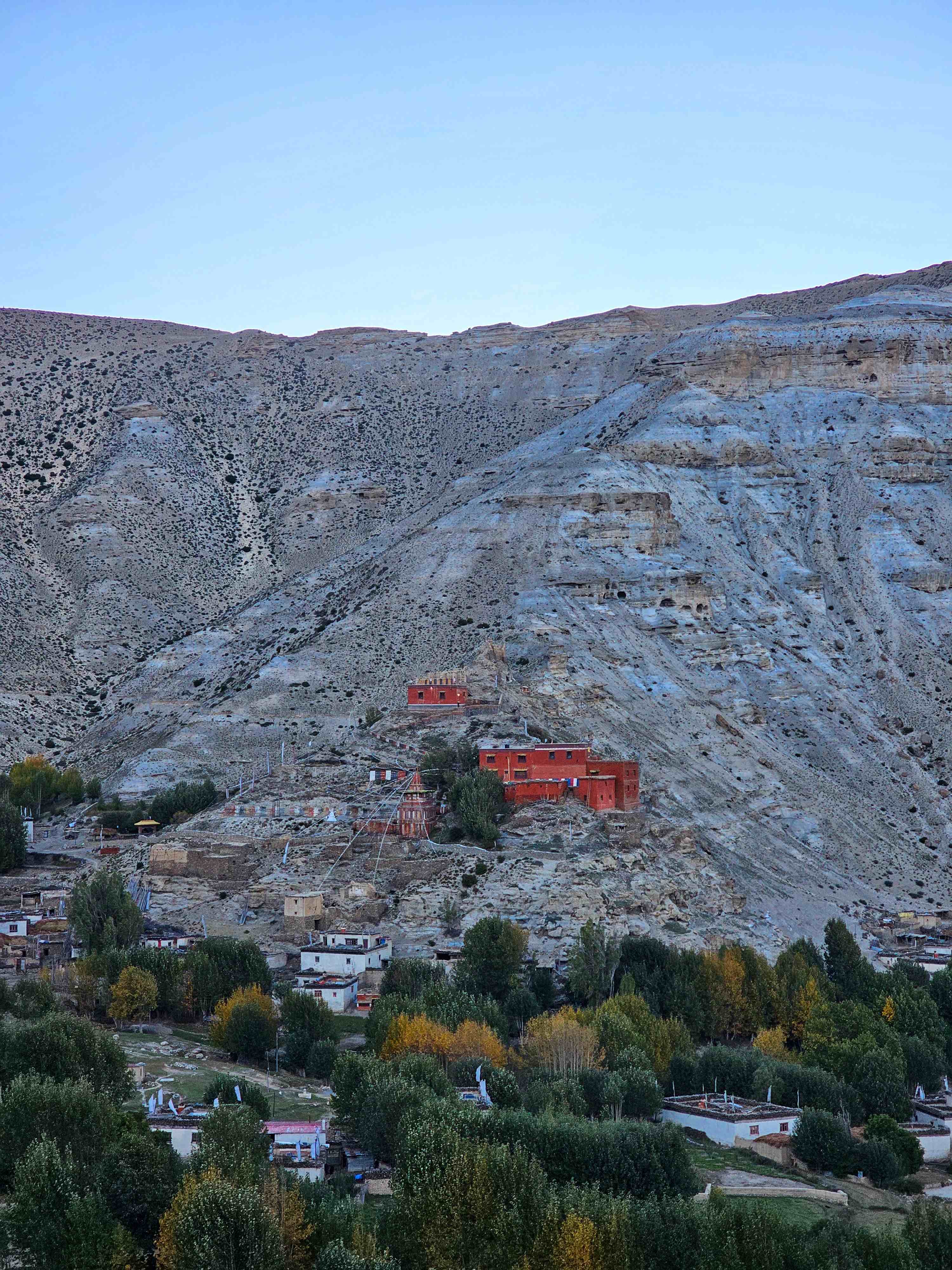
Lo Manthang: More Than a Walled City
A full day of the expedition is dedicated to exploring Lo Manthang.
This is important because arriving at the former capital is only part of understanding it. Time allows you to move beyond the first impression of its walls and narrow lanes and to appreciate the architecture, monasteries, palace and surrounding settlements.
Lo Manthang reflects the history of the former Kingdom of Lo while remaining a living settlement.
The communities of Upper Mustang continue to live within a region shaped by Tibetan Buddhist traditions, agriculture, livestock, trade and increasingly tourism. The city and its surrounding settlements therefore offer a glimpse into a culture that has endured while also adapting to a changing world.
Beyond Lo Manthang: The Journey Continues
Reaching Lo Manthang does not mark the end of the horseback expedition.
The route continues from Lo Manthang towards Dhakmar and Sangboche before returning through Samar, Kagbeni and Jomsom. This return route provides another perspective on a landscape that has already become familiar.
Travelling through the same wider region in a different direction can change the way you see it. Valleys appear from new angles, familiar settlements become reference points, and the scale of the journey becomes clearer.
The return is therefore part of the expedition rather than simply a transfer back to the starting point.
Dhakmar and Sangboche
After Lo Manthang, the trail leads towards Dhakmar and then Sangboche.
These settlements form part of the wider network of communities that make up Upper Mustang. They illustrate an important reality of travelling here: the region is not simply a collection of famous destinations. It is a living landscape of villages connected by trails, livelihoods and long-standing cultural relationships.
Agriculture remains possible in selected areas despite the harsh climate and limited growing season. Livestock continues to play an important role, while tourism has created additional opportunities for local guides, horsemen, lodge owners, drivers and other community members.
The journey therefore passes through a region where ancient traditions and modern economic realities exist side by side.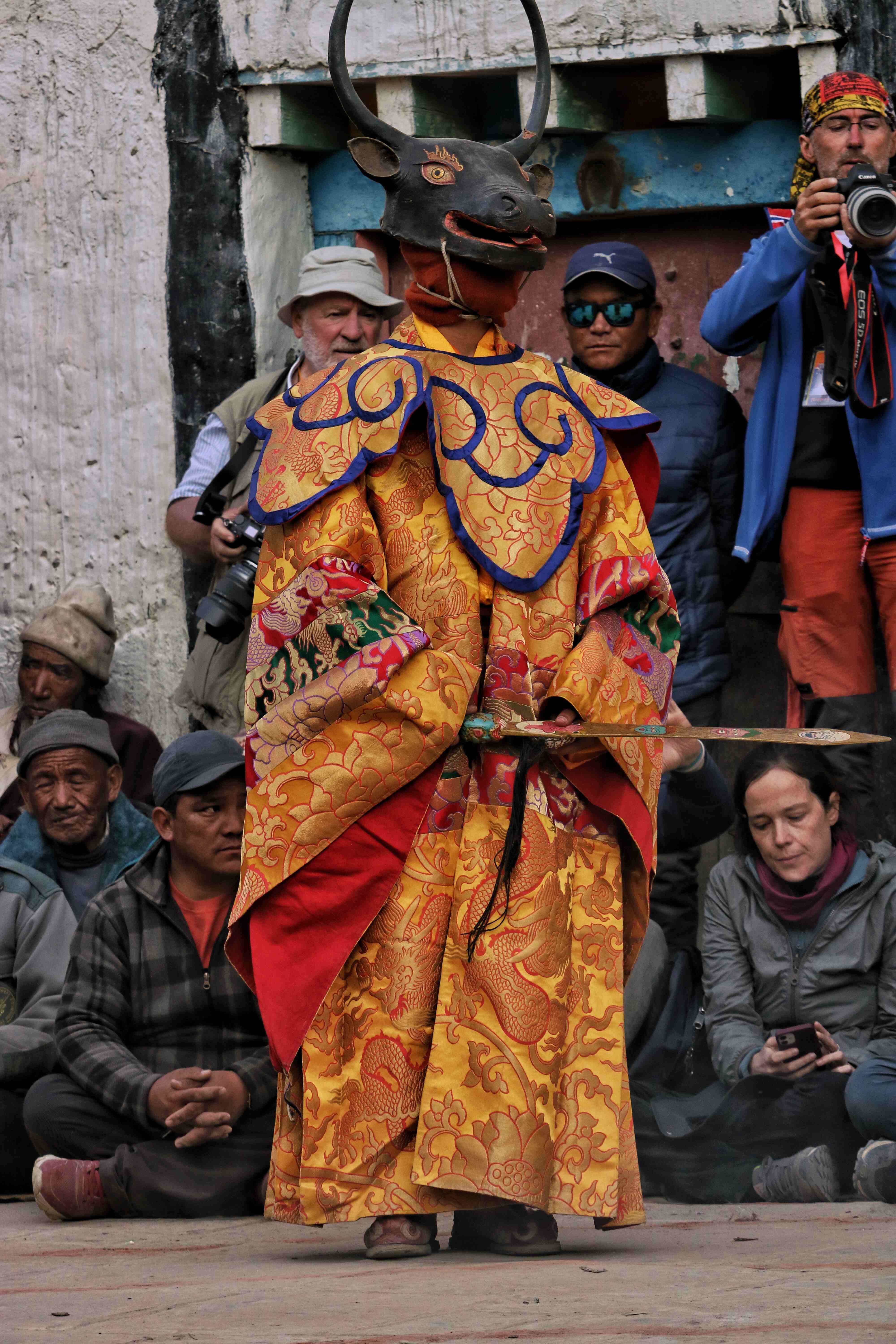
The Ancient Relationship Between Horses and Mustang
The horse is not simply transportation for this expedition.
Horses have been part of Mustang’s way of life for generations. Historically, they helped transport people and goods along the trading routes that connected the region with Tibet and lower Nepal.
The horses traditionally used in Mustang, often described as Mustang horses or Tibetan mountain ponies, are generally smaller than many Western riding breeds. They are strong, agile and sure-footed, qualities that suit the rocky trails, steep terrain, riverbeds, high altitude and changing weather of the Himalayas.
These are working horses.
Even today, horses may be used to transport agricultural products, food supplies, firewood, construction materials and other goods in places where modern vehicles remain limited. Their role therefore extends beyond tourism and remains connected to rural livelihoods.
Travelling With Mustang’s Working Horses
Travellers should understand that a horseback journey through Upper Mustang is different from riding at a professional equestrian centre or recreational ranch.
The horses are part of a traditional Himalayan working environment. Their appearance and condition may differ from what travellers accustomed to recreational or competitive riding expect.
This is not a polished equestrian holiday.
It is a mountain expedition rooted in the realities of Mustang.
Tourism can nevertheless create an additional source of income for horse-owning families and local horsemen, giving horses continued value within communities whose traditional livelihoods are changing. Local horsemen also bring knowledge of horse behaviour, mountain trails, weather, altitude and local conditions that is difficult to replace with outside expertise.
During longer expeditions, horses may be rotated or additional animals used where possible, allowing individual horses periods of rest.
For travellers who appreciate rural Himalayan life and want to understand the traditional role of horses rather than simply use them as recreational transport, this becomes an important part of the experience.
The People Along the Trail
The landscapes of Upper Mustang are extraordinary, but the journey would be incomplete without the communities living among them.
People here have adapted to one of the Himalayas’ harshest environments. Agriculture, livestock and trade have historically supported households, while tourism has become increasingly important in recent years.
The local horsemen accompanying the expedition are particularly important to the experience. Their familiarity with the animals and terrain provides practical knowledge throughout the journey, from understanding the horses to recognising the conditions of mountain trails and weather.
Accommodation also reflects the character of the region.
Rather than staying exclusively in large hotels, the expedition uses local mountain lodges and guesthouses, with locally prepared meals along the horseback journey. This creates opportunities for genuine interaction with communities in remote Himalayan settlements.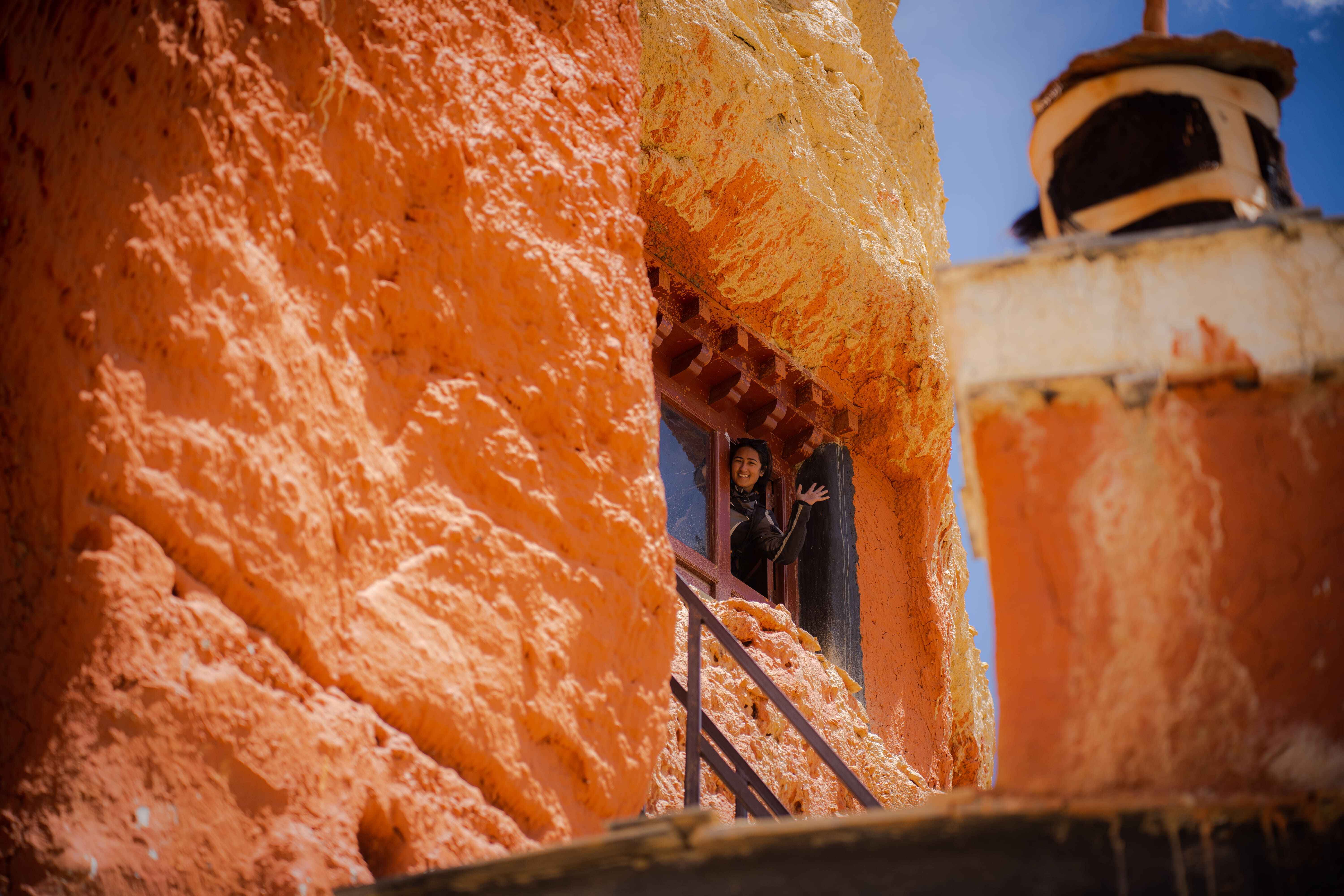
A Landscape That Is Changing
One of the most interesting aspects of travelling through Upper Mustang today is seeing a region in transition.
For generations, communities were shaped by geography, trade, agriculture, livestock and religious traditions. Today, roads and modern construction are changing the physical landscape, while younger generations increasingly leave remote settlements for education and employment.
Tourism has become another part of this transformation.
It provides income for guides, horsemen, lodge owners, drivers and other local communities. At the same time, monasteries continue to function, festivals continue to be celebrated, and traditional practices remain part of everyday life.
Upper Mustang is therefore neither frozen in the past nor completely transformed by modernity.
It is a living region adapting to change.
The Rhythm of a 20-Day Expedition
A journey of this length develops its own rhythm.
The first part is about moving towards the mountains. Kathmandu gives way to Pokhara, Pokhara to Jomsom, and the road eventually gives way to the horse.
Then the pace slows.
Days are shaped by mountain trails, changing terrain, remote settlements and altitude. There is time to observe the landscape rather than constantly move through it. The acclimatization day in Samar creates space for the body to adjust before continuing higher, while the full day in Lo Manthang creates space to explore rather than simply arrive and leave.
The return then becomes another chapter of the expedition, carrying you from Lo Manthang through Dhakmar, Sangboche and Samar before descending towards Kagbeni and Jomsom.
That is what makes the 20-day journey different.
There is enough time for the destination to become part of a larger story.
From Jomsom Back to Kathmandu
After returning by horseback to Jomsom, the expedition changes once again.
A flight takes you from Jomsom to Pokhara, followed by a connecting domestic flight to Kathmandu, weather conditions permitting. The mountain flight can offer aerial views of the Annapurna and Dhaulagiri ranges on clear days, providing a final perspective on the mountains you have spent the previous weeks travelling through.
Back in Kathmandu, there is time to rest and enjoy the city at leisure before the final departure from Nepal.
After nearly three weeks on the trail, the contrast between the high desert of Mustang and the energy of Kathmandu can feel considerable.
Why Horseback Changes the Experience
There are many ways to visit Upper Mustang.
A horseback expedition is different because the journey itself becomes central.
You move slowly enough to notice the details of the landscape. You travel along trails that connect settlements rather than simply following roads. You become aware of the terrain beneath the horse, the changing altitude, the wind, the cliffs and the villages ahead.
The horse also connects the modern traveller with an older part of Mustang’s history.
For centuries, animals carried goods and people through these mountains. Travelling on horseback today does not recreate that history, but it allows you to experience the same kind of landscape through a form of movement that remains part of local life.
What Makes This 20-Day Journey Different?
The greatest difference is time.
Time to travel from Kathmandu into the Kali Gandaki Valley.
Time to transition from the road to horseback.
Time to move gradually from Kagbeni towards Chuksang, Samar, Giling, Ghami, Tsarang and Lo Manthang.
Time to acclimatize.
Time to spend a full day in the historic capital of the former Kingdom of Lo.
And time to continue beyond Lo Manthang before returning through Dhakmar, Sangboche, Samar, Kagbeni and Jomsom.
The expedition is not designed around reaching Lo Manthang as quickly as possible.
It is designed around experiencing the journey that leads there.
Following Mustang’s Ancient Trails
Upper Mustang has often been described through its dramatic scenery: red cliffs, barren valleys, high plateaus and ancient caves.
But the deeper story lies in the relationship between this landscape and the people who have lived here.
The ancient trade routes connected Nepal and Tibet. Horses helped carry goods through the mountains. Villages developed around agriculture, livestock, trade and religious traditions. Monasteries and Buddhist structures became part of the cultural landscape. Today, roads, tourism, education and migration are changing the region, but many traditions continue.
A horseback journey brings these different layers together.
You see the landscape.
You follow the trails.
You meet the communities.
You travel with the animals that remain part of Mustang’s rural life.
And eventually, you arrive at Lo Manthang.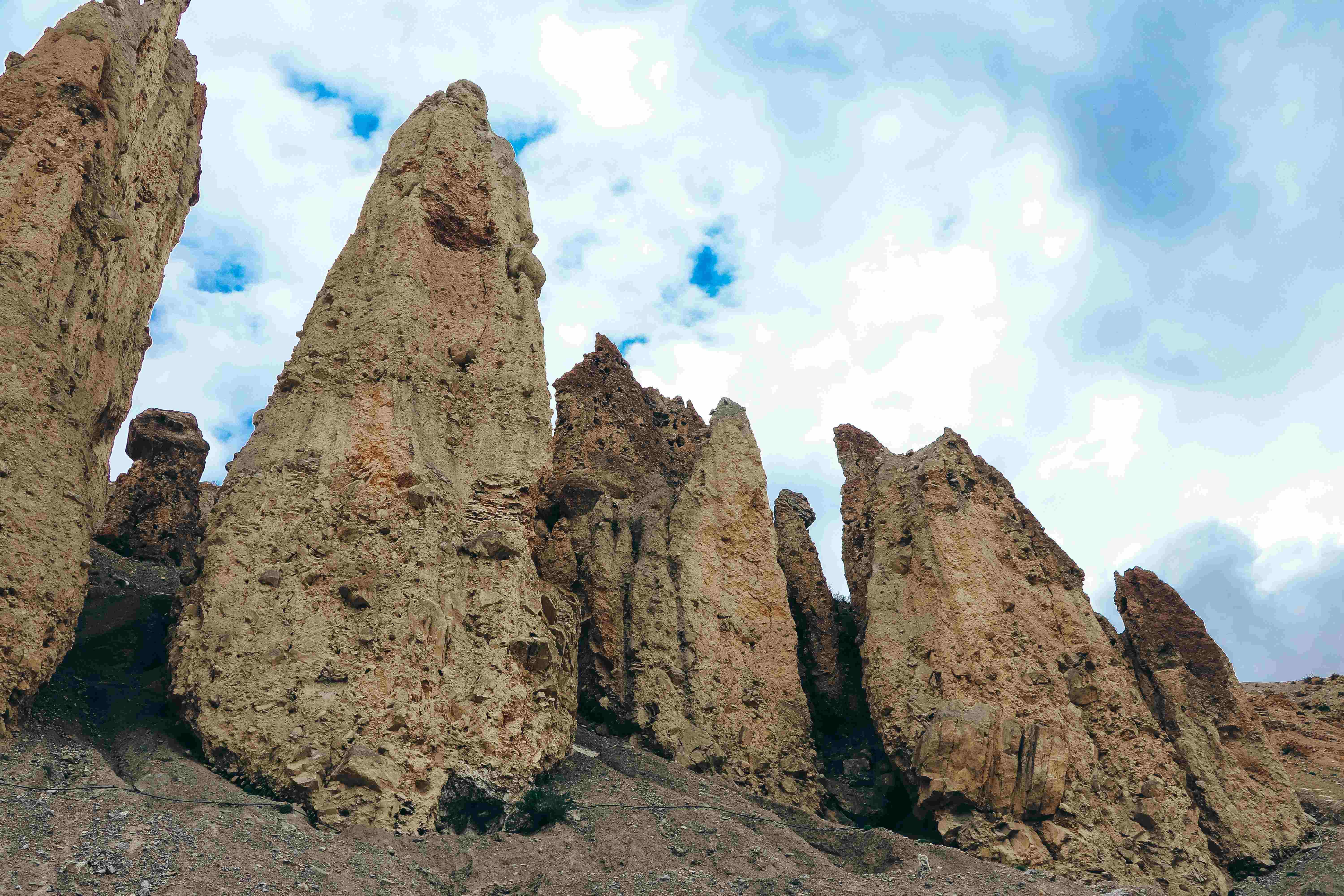
A Journey Rather Than a Destination
The 20-day horseback journey to Lo Manthang is ultimately about more than reaching the historic capital of the former Kingdom of Lo.
It is about travelling slowly enough to understand the landscape that surrounds it.
From Kathmandu to Pokhara, from Pokhara through the Kali Gandaki Valley to Jomsom, and from Jomsom into Upper Mustang on horseback, the journey gradually strips away the familiar landscapes of Nepal and reveals something much more remote.
Kagbeni becomes the gateway. Chuksang, Samar, Giling, Ghami and Tsarang become chapters along the trail. Lo Manthang becomes the cultural centrepiece. Dhakmar and Sangboche become part of the return journey.
And throughout it all, the mountains remain the constant presence.
For travellers looking for an experience that combines horseback travel, Himalayan landscapes, Tibetan-influenced culture, ancient trade routes and the living heritage of one of Nepal’s most distinctive regions, this is a journey measured not simply in kilometres, but in experiences.
You do not simply ride to Lo Manthang. You follow the trails, valleys, villages and stories that lead to it.
Experience Mustang Beyond the Ordinary
Frequently Asked Questions
1. Why is the 20-day Upper Mustang horseback journey considered one of Nepal’s most epic horse treks?
The journey combines high-altitude riding, remote Himalayan valleys, ancient trails, dramatic cliffs, traditional villages, monasteries, caves, and the historic walled city of Lo Manthang. The length of the expedition also allows travellers to experience Upper Mustang beyond its main highlights, making it as much about the journey as the destination.